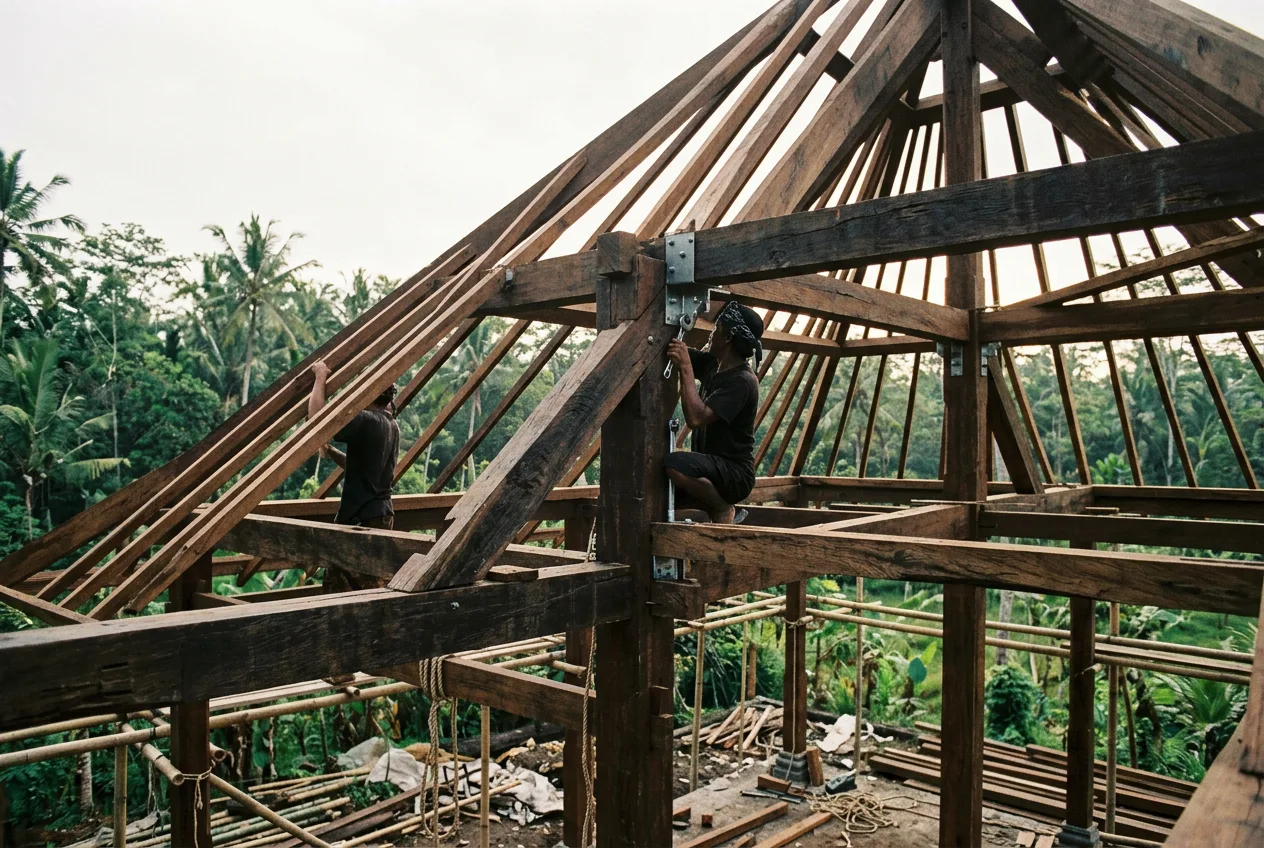
The first design meeting for a Balinese villa is not about the view or the pool. It is about the ground. Indonesia is one of the most seismic countries in the world, and Bali is no exception: everything we have built there was built knowing it — and paying for it, because structural safety is a cost line, not a formality.
A code that tightened
Indonesian seismic design is governed by standard SNI 1726; the 2019 revision replaced the 2012 edition and adopted new hazard maps: depending on the zone, design seismic forces rose by roughly a quarter. Concretely, a building designed to the earlier maps may be undersized under the current code — one of the checks we impose in due diligence whenever an existing asset enters an operation: the structural design date matters as much as the delivery date.
Timber follows its own rules: specification SNI 7973 governs the design of timber structures, and species are graded by strength. A roof frame is not built from cladding wood. On our sites, every timber lot arrives graded and certified, and the critical connections — where frame meets concrete — receive mechanical connectors sized for seismic effort, not just static load.
In the tropics, the picturesque is a consequence. Structure is a calculation.
The tropical triangle: earthquake, humidity, termites
The earthquake is only the first of three adversaries. Permanent humidity attacks steel and rots poorly ventilated timber; termites do the rest. Our answers are constant from one site to the next — from Bali to the Dominican Republic: increased concrete cover, autoclave-treated timber kept clear of the ground, physical rather than chemical termite barriers where the site allows, and cross-ventilation that is not an aesthetic choice but a durability strategy.
Land, the last foundation
Building solidly on fragile rights protects nothing. Indonesian land law reserves freehold to nationals; foreign investment structures operate through temporary real rights — building or use rights — granted in successive periods (typically thirty years, extendable). The soundness of a Balinese operation is read in two documents: the structural calculation and the chain of title. We commit nothing until both are equally clean.
What it costs, what it is worth
The cumulative premium of these requirements — structure, treatment, titles — represents several points of the construction budget across our sites. We have never regretted it. A well-built tropical asset ages remarkably; a badly built one does not age, it decays. The difference does not show in delivery photographs. It shows ten years later.